
The world of Fortnite has never felt larger—or more mysterious—than when a player is dropped into a Fortnite Geoguessr challenge armed only with their wits and a blurred recollection of past battle royale matches. Unlike the standard game, where survival hinges on build speed and aim, this browser-based experience turns the sprawling island into a puzzle box. Each round acts like a memory pressure test, squeezing the player’s spatial knowledge until every pixel of a dusty road or a specific tree formation becomes a potential confession. By 2026, the tool has evolved far beyond a simple side game; it now serves as a training ground for competitive squads, a content goldmine for streamers, and a brutal arbiter of just how closely someone has been paying attention during thousands of matches.
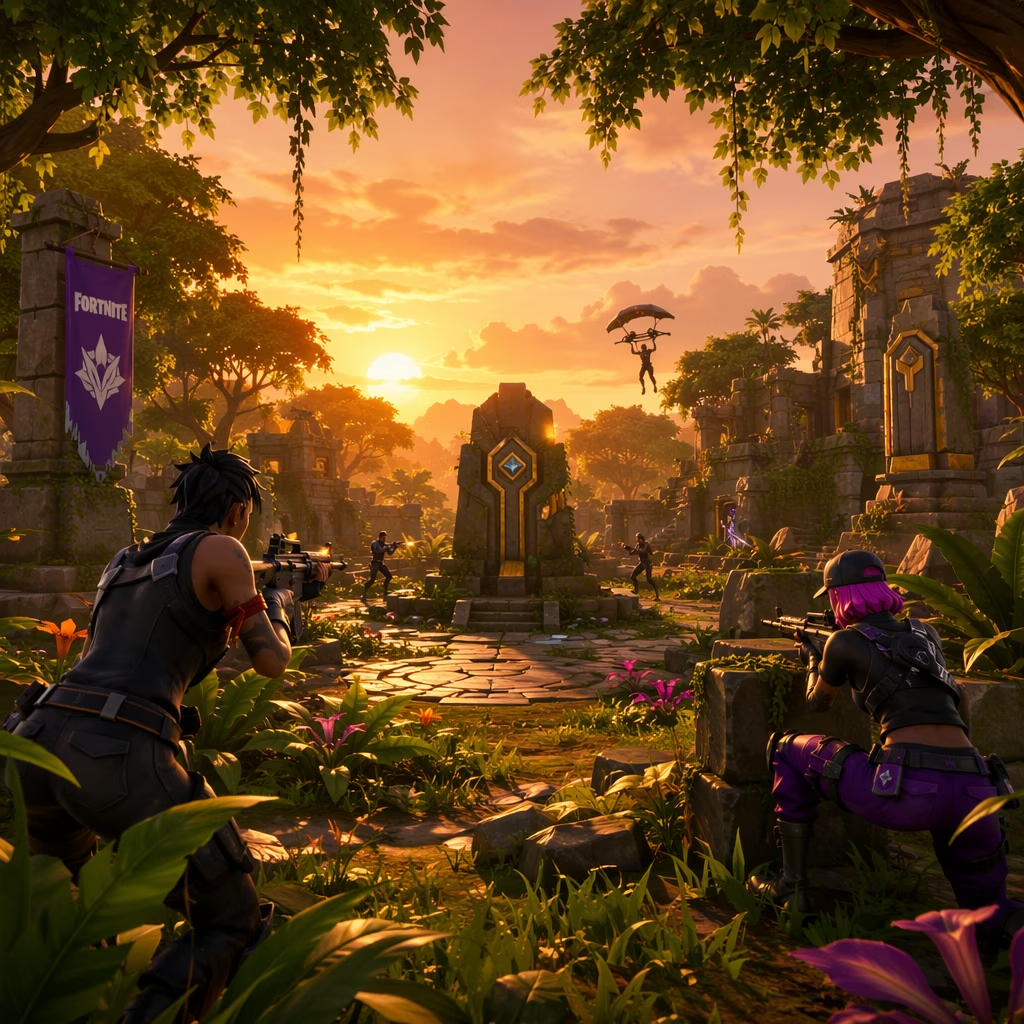
Players are not just guessing coordinates. They are performing a kind of digital forensics, peeling back layers of seemingly generic biomes to uncover the fingerprints of a map that has been reborn more than a dozen times since 2017. The introduction of Chapter 6’s reality-altering zones in late 2025 only deepened the challenge. Landmarks like Neon Nexus might shimmer with yesterday’s aesthetic, yet a seasoned Geoguessr player knows that the angle of a particular holographic billboard or the crack pattern in a futuristic pavement tile can whisper the exact quadrant. The game itself lives at the well-known community hub, Lost Gamer, where the most current map snapshot awaits. Before a round even begins, it is wise to ensure the selected map matches the live season; nothing unravels a carefully crafted guess faster than realizing the terrain reflects a version from three months ago.
The Anatomy of a Guessing Round
Once the game starts, the screen presents a static, 360-degree panoramic image extracted from Fortnite’s engine. There is no sprint bar, no glider redeploy, and no friendly ping from a squadmate. Only silence and the view. Immediately, the player’s eyes become detectives interrogating the landscape. The first sweep scans for towering, named POIs—but the true test comes when the image is just a stretch of autumn-red trees and a river bend. Here, the mind must shift gears from naming landmarks to deciphering terrain tectonics. The process resembles an archaeologist brushing dust from a broken pot sherd, where the exact curve of a river’s meander and the color of the soil can date and locate the fragment.
After soaking in every clue, the player’s gaze shifts to the minimap nestled in the bottom-right corner. This small, unassuming square is the canvas where intuition meets precision. Instead of a chaotic spray of guesses, the best players treat the minimap like a watchmaker’s dial, zooming in and out with deliberate, surgical clicks. They align the direction of a visible mountain peak in the panorama with the elevation lines on the minimap, mentally triangulating their position as if they were plotting a course using a sextant in a digital ocean. When the spot is chosen, the cursor hovers, the hand steadies, and the 'Make Guess' button beneath the minimap is pressed with the gravity of a final exam submission. The game then calculates the score by measuring the exact in-game meters between the pin and the true location, delivering a feedback sting—or a warm rush of validation.
Strategies Etched in Terrain
Surviving a round with less than 50 meters of error requires more than luck. Proficient Geoguessr players develop a mental library of silent markers. They notice that the canopy density in the north-eastern forests creates a particular dappled light pattern through the Unreal Engine’s lighting system. They memorize the barely visible power lines that thread through the countryside like stitches on a patchwork quilt, each section connecting specific transformer stations that appear on the full map. An especially devious trick used by high-score chasers involves listening to the ambient sound loops that sometimes accompany images; the distant, muffled hum of an energy plant or the echo of a waterfall’s roar can skew a guess into a completely different biome if misidentified, but when recognized correctly, it acts as an acoustic lighthouse.
Another layer of the meta involves the rhythm of road wear. Asphalt that has been battle-scarred by repeated vehicle collisions in hot-drop zones appears subtly different from the pristine stretches in untouched coastal areas. Players train themselves to spot the ghost of combat, even in a still image. This transforms the game into a palimpsest—a manuscript where the original text (the designed landscape) has been partially erased and written over by the collective memory of millions of fights, each skid mark and bent railing a footnote to the map’s true identity.
A Living Community Cartographic Trial
By 2026, Fortnite Geoguessr has become deeply integrated into the wider Fortnite culture. Professional esports coaches use it to sharpen their team’s rotational awareness, offloading the burden of map memorization from frantic in-game moments to calm, deliberative practice. Content creators on platforms like Twitch and TikTok have turned guessing sessions into interactive spectacles, where chat rooms explode with conflicting coordinates, and the host’s wrong guess can become as memorable as a Victory Royale. The tool also serves as a bittersweet museum; it often preserves views of locations that have since been consumed by the game’s narrative events, making each guess a nostalgic pilgrimage to places that only exist in the collective digital memory.
Ultimately, Fortnite Geoguessr does not just test knowledge—it reshapes it. Each session sands down the rough edges of a player’s mental map until the entire island becomes as familiar as a hometown. It proves that even in a constantly shifting metaverse, the art of careful looking and the thrill of placing a pin exactly on the spot remain one of gaming’s most satisfying challenges.